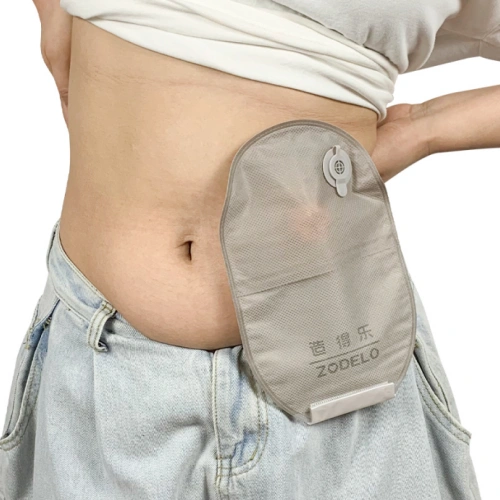
Ostomy Flange vs Wafer: What’s the Difference and Are They the Same Thing?
Table of Contents
When sourcing or specifying ostomy care products, many buyers and brand owners encounter a surprisingly common question.
Is an ostomy flange the same as a wafer?
The confusion often arises when reviewing product specifications from different suppliers, reading clinical guidelines, or communicating across international markets. One ostomy manufacturer refers to a “flange,” while another uses the term “wafer”. Sometimes for what appears to be the same component.
This article clarifies: ostomy flange vs wafer from a practical and manufacturing perspective. Rather than focusing on marketing terms, we explain how these terms are actually used in modern ostomy systems, why both exist, and what truly matters when sourcing or specifying ostomy products.
What Is an Ostomy Wafer?
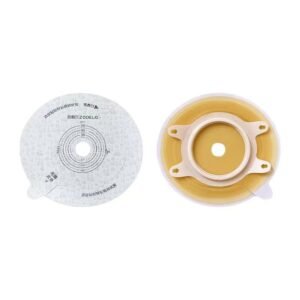
When it comes to ostomy flange vs wafer, the first thing to understand what is the ostomy wafe. The Ostomy wafer, also known as a skin barrier or baseplate, is the core component directly attached to the skin in the ostomy system. The main function of the Ostomy Wafer is to form a reliable seal around the ostomy (creating a seal) and hold the entire ostomy bag in place. It also protects the peristomal skin (the skin around the ostomy) from irritation and leakage.
The Ostomy wafer typically consists of the following key components:
- Skin barrier material: Usually made of hydrocolloid or composite materials, it is used to absorb moisture and reduce skin irritation.
- Adhesive layer:Responsible for firmly attaching the baseplate to the skin surface, while also balancing stickiness and comfort during removal.
- Stoma opening:Depending on the design, it can be a pre-cut hole, one that needs to be self-sewn, or a moldable structure.
- Connection area (for two-piece systems):Used for mechanical or adhesive connection with the ostomy bag.
Different Types of Ostomy Wafers Available
Ostomy wafers are generally classified into the following three major categories:
- Pre-cut ostomy barriers
- Cut-to-fit barriers
- Moldable wafers
What are Pre-Cut Ostomy Barriers (Wafers)?
When it comes to ostomy flange vs wafer, we also need to know what is the pre-cut ostomy barriers. Pre-cut ostomy barriers refer to wafer-shaped devices that have been pre-cut to a fixed size. This ensures that patients can use them without having to cut them themselves.
Applicable population and scenarios:
- Long-term users with stable stoma sizes
- Users in clinical or home care who prefer simple operation
- Scenarios where medical staff need to manage and use them in batches
What are Cut-to-fit Barriers (Wafers)?
Cut-to-fit barriers refer to the base plates that need to be cut by the user according to their own stoma size. The opening area is reserved for the cutting range, usually with size reference lines. They are highly flexible and highly adaptable.
Applicable population and scenarios:
- Patients whose stoma size is not yet stable in the early postoperative period.
- Users with irregular stoma shapes.
- People who hope to achieve a more precise and fitting effect.
What are Moldable Wafers?
When it comes to ostomy flange vs wafer, we also need to know what is the moldable wafers. The opening areas of the moldable wafers are made of plastic materials. There is no need for cutting. Users can shape the openings to the desired size with their fingers. The material of the opening areas will naturally retract and fit around the stoma.
Target users and scenarios:
- People with limited hand dexterity and difficulty in using scissors.
- People who want to reduce the number of cutting steps and improve wearing efficiency.
- Long-term users with high requirements for fit and seal.
What Is an Ostomy Flange?
Ostomy flange, also known as baseplate or skin barrier. Is a key component in the stoma bag system that directly contacts the patient’s skin and is fixed around the stoma. In the Two-Piece pouch system, the flange is an independent component and is connected to the bag body by means of snap or bonding. In the one piece stoma bag system, the flange and the bag body are formed in one piece.
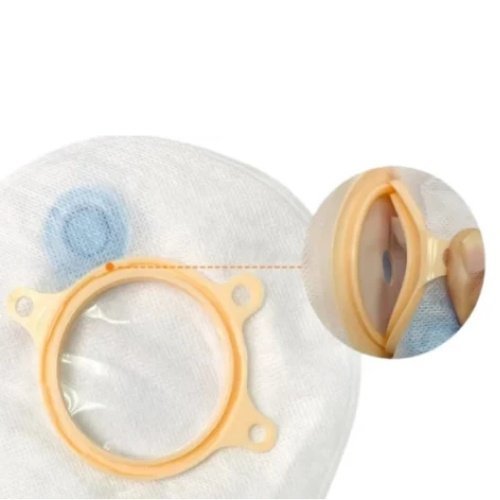
The core function of the flange for stoma bag is to firmly fix the stoma bag to the abdominal wall. Form a reliable seal between the stoma and the skin. Prevent excrement from leaking. This protects the skin around the stoma from irritation. The design and quality of flanges directly determine the safety, comfort and complication rate of stoma care.
Types of flange/wafer/skin barrier for stoma bag
When it comes to ostomy flange vs wafer, we also need to know types of flange for stoma bag.
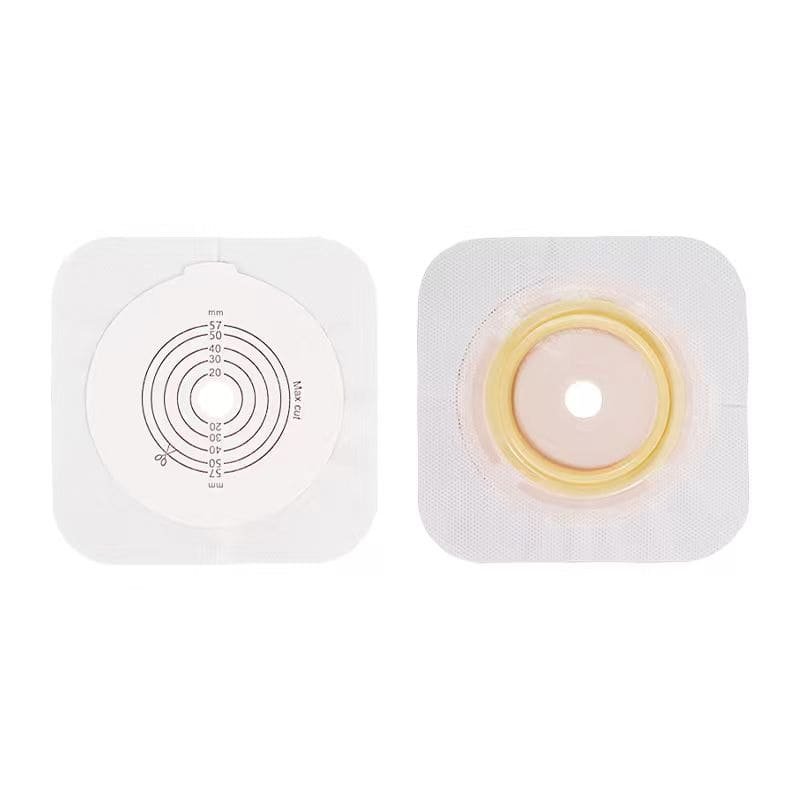
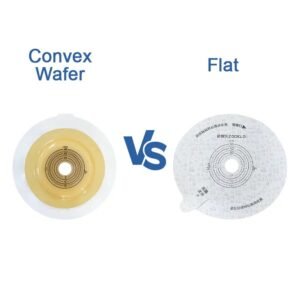
1. Flat wafer/skin barrier
It is suitable for protruding or normal-height stomas. Or patients with a flat abdominal wall without obvious folds or depressions.
Advantages: Light and thin wearing experience, high comfort level.
Defect: Limited sealing performance for retractable stomas or irregular abdominal walls.
2. Convex wafer
The center of the flange protrudes outward, exerting a gentle pressure on the flange. It has stronger sealing performance. It can significantly reduce the risk of leakage.
It is suitable for retracting stomas, which are flush with the skin. The abdominal wall is uneven and sunken after the operation.
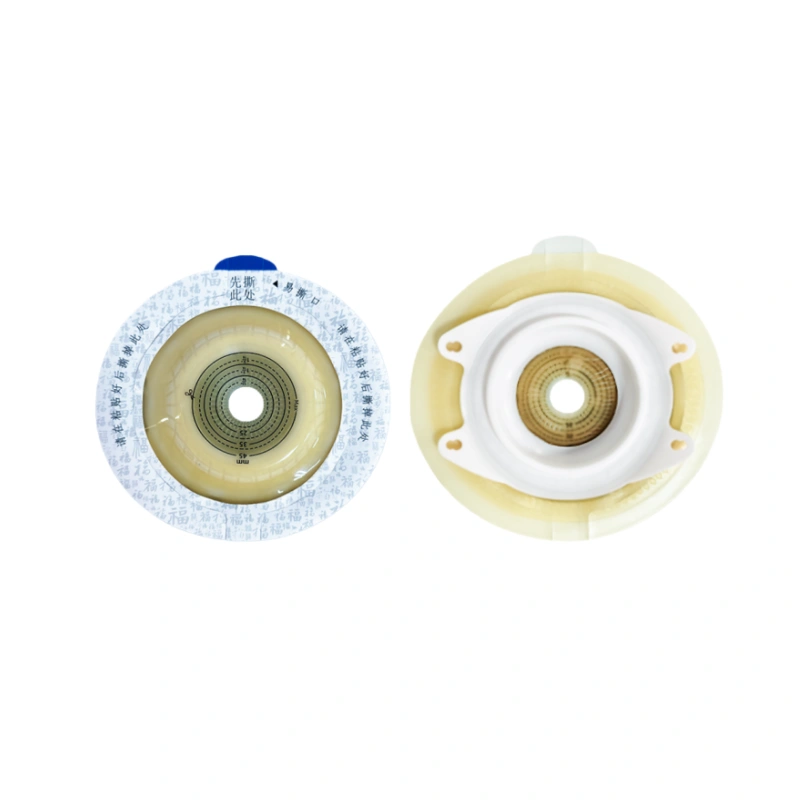
3. Deep Convex Flange
Provide stronger support and external thrust.
It is suitable for people with severe retraction or high leakage risk.
It is usually recommended to use it in combination with an ostomy belt.
Careful assessment is needed to avoid excessive pressure on the stoma.
What’s the Difference Between ostomy flange vs wafer?
In different countries and regions, the ostomy industry has adopted different names for the same component.
In the North American market (especially in the United States), “wafer” is more commonly used. It is frequently seen in clinical training materials, nurse education, and patient instructions. It emphasizes its “flat base attached to the skin” attribute.
However, in the European and other international markets, “flange” is used more frequently. It is particularly common in technical documents, product specifications, and factory materials. It emphasizes its “connection and structural interface” attribute.
In a two-piece pouch system, the wafer simultaneously performs the functions of skin protection and pouch connection, while the flange is the structural part used for connecting the pouch. In a one-piece pouch system, the wafer is part of the overall structure and there is no separate flange interface.
The specific differences between ostomy flange vs wafer can be referred to in the following table.
| Ostomy Flange | Ostomy Wafer(Baseplate / Skin Barrier) |
Core Definition | The interface structure used to connect the pouch in the two-piece system | The adhesive base that comes into direct contact with the skin and the skin barrier |
Common Usage Scenarios | Two-piece ostomy bag system | One-piece & two-piece systems are applicable |
Main Focus Points | Mechanical connection stability, interface size, locking structure | Skin protection, adhesion force, wearing comfort |
Whether Independent Existence | Usually does not exist independently, it is part of the wafer | Can exist as a complete functional component |
Contact with Skin | Does not directly contact the skin | Direct contact with the skin around the ostomy |
Whether Affecting Compatibility | Is the factor that determines whether the pouch can be connected | Indirect influence (through sealing and stability) |
Key Technical Parameters | Interface diameter (45 / 55 / 70mm) connection method (clip / adhesive) | Thickness, flexibility, and wearing duration of the skin barrier material (hydrocolloid / ceramide) |
Cross-Brand Universality | Usually cannot be used across brands | Usually needs to match the system of the same brand |
Presence in One-Component System | Does not have an independent flange | Is an integrated structure |
Common Clinical/Market Terms | Engineering, manufacturing, procurement communication | Clinical care, patient education, product instructions |
Common Misunderstandings | The same size can be universally used | Just the adhesive base, does not affect performance |
Ostomy Flange vs Wafer in One-Piece and Two-Piece Ostomy Pouch Systems
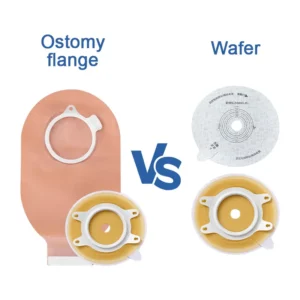
In a one-piece pouch system, the ostomy flange vs wafer have virtually no difference in practical terms.
In a two-piece pouch system, they usually refer to the same base plate. But in engineering or manufacturing contexts, the flange is sometimes used to emphasize the connection structure.
| One-Piece Pouch System | Two-Piece Pouch System |
System structure | The base plate is permanently integrated with the ostomy bag. | The base plate can be separated from the ostomy bag. |
The meaning of Wafer | It refers to the entire base plate that is attached to the skin. | It refers to the base plate that is adhered to the skin. |
The common meaning of Flange | It is usually used in conjunction with wafers. | It often refers to the entire base plate, and sometimes emphasizes the connection area. |
Is there an independent connection ring? | No | Yes (mechanical or adhesive coupling) |
Does the Terminology Affect Product Compatibility?
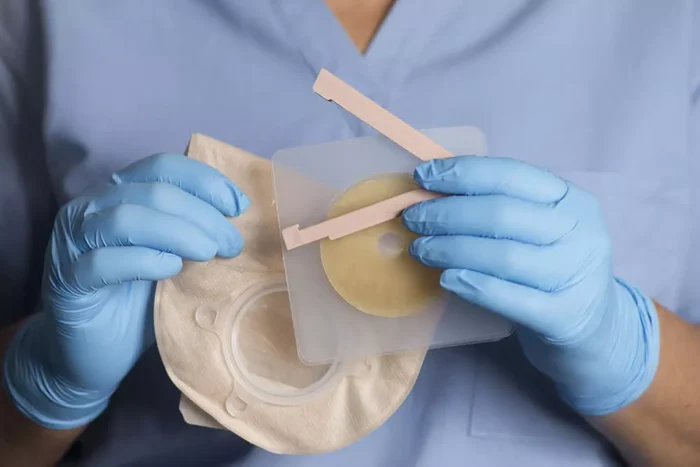
In the field of ostomy care products, the terms “flange” and “wafer (skin barrier/baseplate)” are often used interchangeably, which can easily cause confusion in actual communication. The terminology itself does not directly determine whether the products are compatible, but incorrect understanding of the terminology is very likely to lead to selection errors and usage risks.
The following factors are the key to determining whether ostomy bags are interchangeable:
1. System type: One-piece pouch system vs Two-piece pouch system
One-piece pouch system: The wafer and the pouch are integrated. There is no flange mechanical interface. There is no cross-brand compatibility issue.
Two-piece pouch system: The wafer and the pouch are detachable. They must match the flange connection specifications.
Different brands are usually not compatible.
2. Flange connection standard
Different connection methods:
mechanical coupling
adhesive coupling
Even if the flange sizes are the same, the locking structures of different brands may not be compatible.
3. Brand-specific design
Most mainstream brands (such as Hollister, Coloplast, Convatec, Zodelo, etc.).
Use a closed brand system.
It is clearly not recommended to mix brands.
Mixing brands may result in: leakage risks, detachment or other series of problems.
Common Misunderstandings About Ostomy Flange vs Wafer
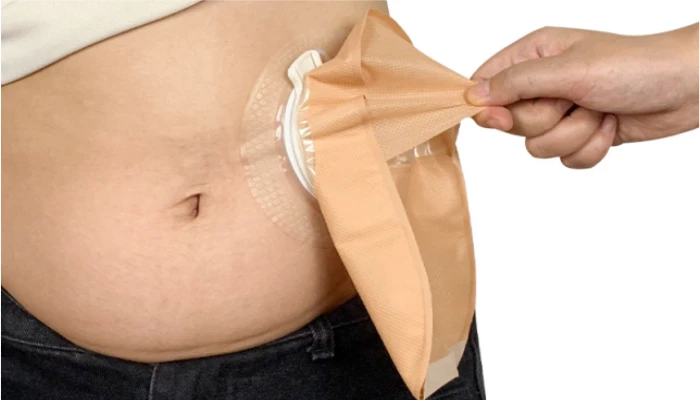
Misunderstanding 1: Ostomy Flange vs Wafer are two completely different components.
In most ostomy systems, they refer to the same core component expressed in different ways.
Wafer (Baseplate / Skin Barrier)
Emphasizes direct contact with the skin, providing a skin barrier.
Absorbs exudate and protects the skin around the ostomy.
Flange
Emphasizes the connection structure with the pouch.
Misunderstanding 2: As long as the Flange sizes are the same, they can be used across different brands.
Fact: The Flange size being the same does not mean that the connection system is compatible.
In a two-piece ostomy system, the factors that truly determine compatibility include:
Connection method: mechanical coupling, adhesive coupling.
Locking structure design
Brand-specific interface standards, etc.
Misunderstanding 3: One-piece systems also have Flange
Fact: One-piece pouch systems usually do not have an independent flange interface.
One-piece pouch system: The wafer and the pouch are formed as one piece. There is no detachable flange connection structure.
Two-piece: The wafer (with flange) + pouch can be separated. The flange is the connection point between the wafer and the pouch.
How to choosing the Right Ostomy Flange vs Wafer
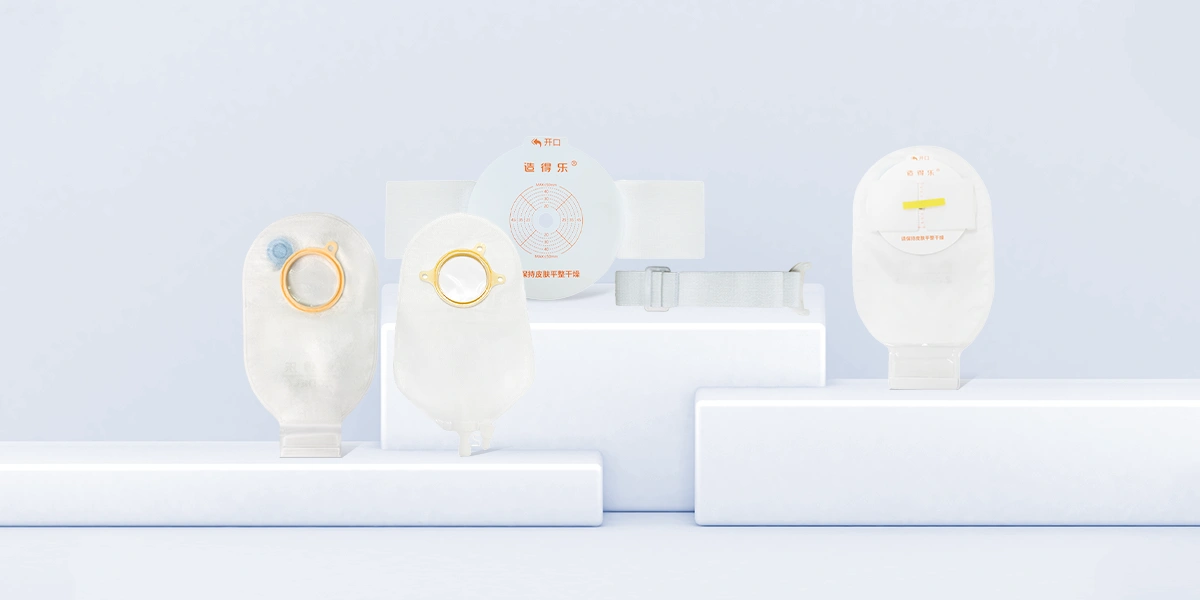
1. Select flange for stoma bag according to the stoma shape
a. Protruding stoma
Suitable for: Flat Flange
Reason: Excrement naturally stays away from the skin. The requirements for abdominal wall sealing are relatively low.
b. A stoma that is flush with the skin or slightly retracted
Suitable for: Convex Flange
Function: Improve the direction of excretion by pushing outward. Significantly reduce the probability of leakage.
c. Stoma with obvious retraction or high risk of leakage
Recommendation: Deep Convex Flange.
Clinical recommendations.
It should be used under the guidance of a stoma therapist first.
When necessary, combine the ostomy belt.
2. Select flange for stoma bag according to the condition of the abdominal wall
The condition of the abdominal wall is often overlooked, but in actual care, it is one of the main factors leading to leakage.
Characteristics of the abdominal wall | Recommended Flange |
Smooth and tight | Flat or slightly convex |
Postoperative depression | Convex surface or deep convex |
Laxity, obesity | Flexible convex flange |
Frequent activities | Stable convex surface or snap-on type |
4. Select the flange material according to stoma type
- Ileostomy: The excrement is liquid and highly corrosive. It is suitable for Extended flange. It features water resistance and erosion resistance.
- Colostomy: Excrement is relatively formed. Suitable for standard or skin-friendly flanges.
- Urostomy: Continuous discharge of urine. Choose moisture-resistant and anti-crystallization flanges.
5. Choose based on your skin condition
- Sensitive skin: Low-allergenic, skin repair type hydrocolloid.
- Prone to redness, swelling or erosion: Avoid frequent replacement and choose long-lasting flanges.
- Need to extend wearing time: High-density hydrocolloid structure.
6. Flange selection for one-piece or two-piece systems
- One-piece flange: Thin, light and concealed. Suitable for people who use it stably on a daily basis.
- Two-piece flange: No need to frequently peel and stick the skin when changing the bag body. Suitable for people with sensitive skin or those who need long-term care.
Conclusion: Ostomy Flange vs Wafer — A Difference in Words, Not Function

Ostomy flange vs wafer, there are both similarities and differences. Whether it is ostomy flange vs wafer, neither is an obstacle to life, but a new starting point for the recovery of physical health. Therefore, each patient needs to truly understand ostomy flange vs wafer. Only in this way can the stoma be cared for in a scientific and reasonable manner.
Zodelo firmly believes that whether ostomy flange vs wafer, their common mission is to help patients live a more comfortable and healthy life. Zodelo will always be by the side of every patient, jointly caring for the stoma, and providing the most professional and high-quality stoma products for all those in need.
Frequently Asked Questions about Ostomy Flange vs Wafer
Q1. Is an ostomy flange the same as a wafer?
In most modern ostomy systems, ostomy flange vs wafer refer to the same skin barrier component. With the difference mainly coming from regional and professional terminology rather than function.
Q2. Does the terminology affect product compatibility?
No. Compatibility depends on size, coupling system, and material, not on whether the component is called a flange or a wafer.
Q3. Do all ostomy brands define flange and wafer in the same way?
No. Definitions may vary slightly between brands, which is why professional suppliers focus on technical specifications instead of terminology alone.
Q4. How Ostomy Wafers Are Usually Sold?
- Separate sale (common in two-piece systems): The base plate and the ostomy bag are sold separately. This makes it convenient for users to replace different components as needed.
- Combined sale with the ostomy bag: Common in one-piece systems. It simplifies the purchasing and usage process. It is suitable for beginners or retail channels.
Q5.Does ostomy flange vs wafer terminology affect patient use or comfort?
No. Patient comfort is determined by fit, seal quality, and skin barrier material. Not by the terminology used to describe the component.
Q6. Is wafer more commonly used in the U.S. market?
Yes. Wafer is the more commonly used term in the U.S. clinical and retail market. While “flange” is often seen in manufacturing and international documentation.
Q7. What information matters more than terminology when ordering ostomy flange or wafer?
Key factors include diameter, wear time, skin barrier formulation, system type, and compatibility requirements. Which professional manufacturers typically confirm during the sourcing process.
Conclusion - One piece ostomy bags
The one piece ostomy bags are not merely a simple medical consumable; it is an essential tool for colostomy patients to regain their confidence and maintain a normal life. Only by correctly understanding the one piece ostomy bags can one scientifically and correctly care for the stoma. Regain a healthier and more comfortable life.
Zodelo is committed to providing high-quality stoma bags and accessories for stoma patients worldwide. We are constantly researching and upgrading ostomy care solutions, strictly adhering to medical safety standards, and providing all stoma patients with a reassuring, comfortable and reliable stoma care experience.
If you have any needs or questions, please feel free to contact us or Get our product catalog!
More Resources about Ostomy Flange vs Wafer
- A Guide to Ostomy Bags and Pouching Systems— Uchicagomedicine.org
- Stoma (medicine)– wikipedia
- The ultimate guide of flange for stoma bag– zodelo
- One Piece Vs Two Piece Stoma Bag: What’S The Difference?– zodelo

Top 10 Urostomy Bag Brands in 2026
Top 10 Urostomy Bag
Convex Wafer vs Flat: What’s the Difference
Convex Wafer vs Flat

Top Ileostomy Bag Brands in 2026
Top Ileostomy Bag Br

Ostomy Paste vs Ring: What’s the Difference
Ostomy Paste vs Ring